
A house in the walled city: where to stay in Cartagena
From a hotel with a jazz rooftop to a colonial house with a courtyard for the whole group: how to choose, and what to check before you book.
The key is usually iron, and heavy in the hand. The door swings open, midday light floods the entrance hall and there at the back is the courtyard: a palm, a fountain, a wooden staircase climbing towards the roof terrace. Cartagena has every kind of place to stay: boutique hotels in colonial houses, whole houses with pools for big groups and thousands of flats on the platforms. The right choice depends on who you're travelling with and how much you want to walk at night.
Living in a colonial house, if only for a few days
Cartagena is a city made of houses. From the day Pedro de Heredia founded it in 1533, merchants, Crown officials and Creole families raised two- and three-storey homes inside the walls, each with an entrance hall, a central courtyard and wooden balconies jutting over the street. The walls that protect them, built between the 16th and 18th centuries after raids like Francis Drake's in 1586, kept the Old City's street plan almost intact, and in 1984 UNESCO declared it a World Heritage Site.
Staying in one of those houses is a way to understand the city from the inside: the courtyard that gives shade at noon, the wooden staircase that creaks, the rooftop where the domes catch the last light. Here, choosing where to sleep matters almost as much as choosing where to eat.
Mornings have their own ritual. Through the Old City walk the palenqueras, in bright dresses with basins of fruit balanced on their heads. They come from San Basilio de Palenque, the town founded by Africans who escaped slavery under the leadership of Benkos Biohó, whose traditions UNESCO recognised as intangible heritage of humanity in 2005.
In Cartagena, choosing where to sleep matters almost as much as choosing where to eat.
I · The hotel
Townhouse: a small hotel, a rooftop and jazz
In the walled city, steps from Plaza Fernández de Madrid, Townhouse is a boutique hotel with a handful of rooms and two bars: a rooftop with plunge pools and views over the tiled roofs, and a lobby bar that turns speakeasy with jazz at weekends.
That square is one of the most literary in the city. In Love in the Time of Cholera, Gabriel García Márquez called it the Park of the Evangels, and from one of its benches Florentino Ariza pretended to read while waiting for a glimpse of Fermina Daza, whose girlhood home the novel places on the same park. The author later acknowledged that it was Plaza Fernández de Madrid.
Best for couples or friends who want a hotel with atmosphere without leaving the Old City.
II · The house
Colonial vacation rentals
For groups (families, birthdays, bachelor and bachelorette parties), a whole colonial house is often the best option: several en-suite bedrooms, a courtyard, a pool or terrace and, often, housekeeping, breakfast and a concierge for transfers, island boats and restaurant bookings. Local agencies specialise in houses in the Old City and Getsemaní, and many also list on the platforms.
If your house is in Getsemaní, it's worth knowing where you're sleeping: on 11 November 1811 this artisans' neighbourhood outside the walls, led by Pedro Romero and his lanceros, pushed Cartagena to declare absolute independence from Spain.
III · The platforms
Airbnb, Booking and Vrbo
- Airbnb: the widest choice of houses and flats in the Old City, Getsemaní, Bocagrande and Manga, plus experiences with local guides.
- Booking: hotels and apartments side by side; handy for comparing prices and booking with flexible cancellation.
- Vrbo: focused on whole homes, good for large groups.
IV · Before you book
What to check before you book
- National Tourism Registry (RNT): in Colombia, tourist accommodation, including holiday homes, must be registered. Many listings show their number; ask for it if it's missing.
- Air conditioning in every bedroom, not just the main one.
- Exact location: the Old City and San Diego are walkable; Bocagrande and Manga are a short drive.
- Noise: the Old City has nightlife at weekends. If you sleep early, look for quieter streets such as those in San Diego.
- Stairs and pools: many colonial houses have two or three floors and no lift.
- Recent reviews and cancellation policies, especially in high season and on long weekends.
Epilogue
The first night
Whatever house you choose, your first night in Cartagena is for walking. The streets change name every block, many of the names inherited from colonial times, and the breeze that rolls in off the sea at sundown draws everyone out onto the balconies and into the squares. That's the moment to drop the bags and head out to dinner.
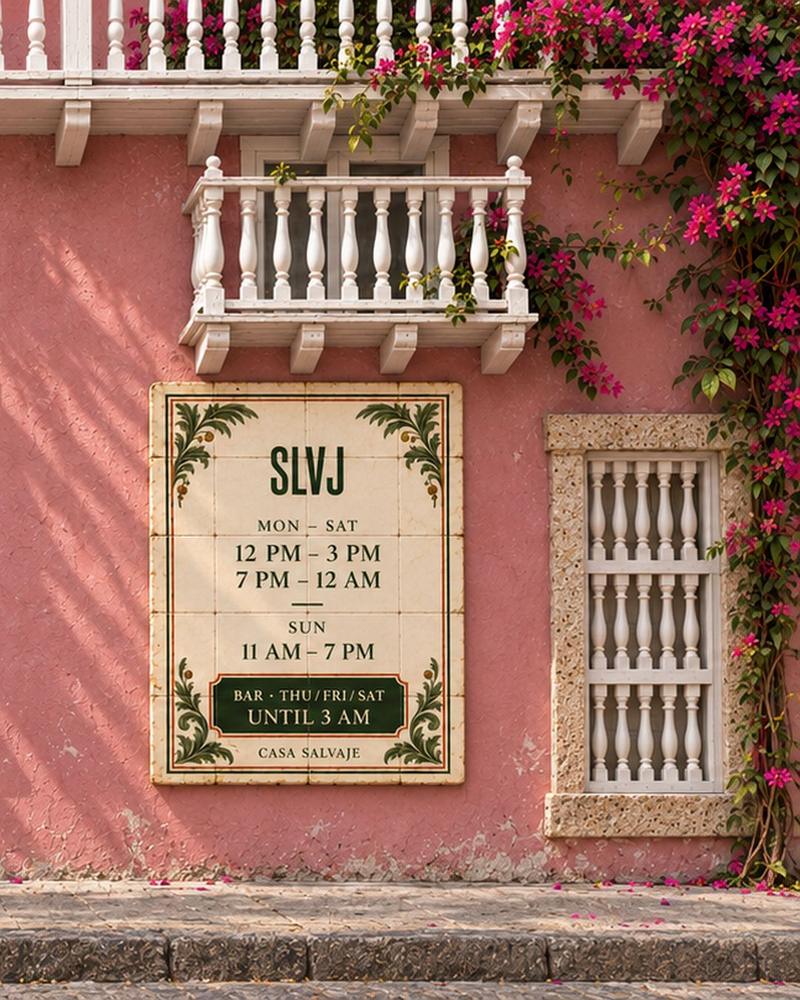
If you're staying in the Old City, Casa Salvaje is a walk away: Calle Santa Teresa #32-41, two blocks from Plaza Santo Domingo. See opening hours and our guides to boutique hotels and more boutique hotels.