Patience first, fire after: where to eat great steak in Cartagena
What sets a good steakhouse apart, how to order the cut and the doneness, and the coals at Kanibal, Fermín Azkue's kitchen in the Old City.
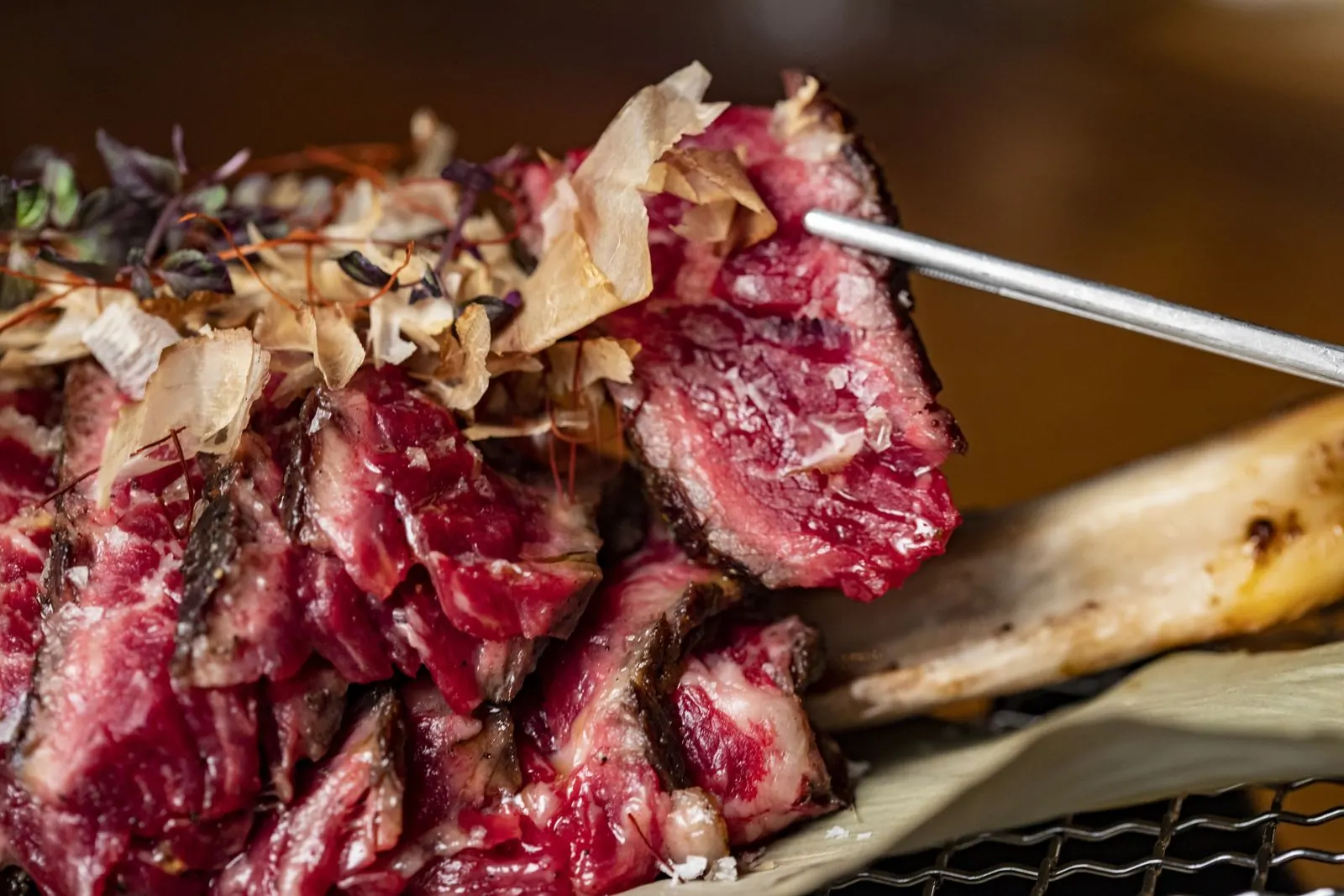
Cartagena lives facing the sea, and yet it knows how to sit down to a good cut of beef. When night falls and the breeze moves through the streets of the Old City, the smoke of the grill is part of the city too. The question is where to eat steak in Cartagena, and what to order once you sit down.
Four things that make a good steakhouse
A good steakhouse gives itself away before the first bite. You only need to look at four things, and you can ask the waiter about all of them.
The first is the cut: where it comes from, how much it weighs and how thick it is. A thick cut holds its juices better over the coals; a thin one dries out before it takes on colour. The second is ageing. Meat that rests in a cold chamber loses water, concentrates its flavour and softens its fibres. A serious kitchen knows the day each piece came in and when it is ready.
The third is the fire. Charcoal gives a crust, smoke and a heat a griddle cannot match. The fourth is doneness: a good steakhouse asks how you like it, respects your answer and lets the meat rest for a few minutes before slicing, so the juices stay inside and not on the plate.
A good cut is never rushed: first it waits in the chamber, then over the coals.
I · The map
Cuts and doneness, demystified
The same names turn up on almost every steakhouse menu. Chateaubriand is the centre of the tenderloin: the most tender cut and the leanest. The New York comes from the loin, along the backbone, with a strip of fat down one side; it has a firm bite and an intense flavour. The rib eye comes from the rib and carries an eye of fat in the middle that melts in the heat: it is the juiciest of the three. "Angus Choice" refers to the breed and to one of the quality grades the United States Department of Agriculture assigns according to marbling. And an ounce is about 28 grams: a 14 oz cut weighs close to 400 g.
Then comes doneness, and it helps to know the Spanish words. Blue (azul) is seared outside and almost raw inside. Rare (rojo, or jugoso) leaves the centre red and warm. Medium (medio) is pink. Medium-well (tres cuartos) keeps just a thread of pink, and well done (bien asado) has none. For a rib eye, rare or medium lets the fat melt; for a chateaubriand, rare. If you like it well done, say so without embarrassment: fattier cuts handle it better than the tenderloin.
II · The house
Kanibal: Fermín Azkue's coals
At Casa Salvaje, fire has a world of its own. At Kanibal, meat ages in the chamber with its tag and its date, fish hangs until it is ready, and everything ends over the coals. That is how Fermín Azkue's kitchen works: patience first, fire after.
The land section of the menu has three cuts. The 10 oz Chateaubriand Kanibal arrives with béarnaise and truffle fries (COP 104,000). The 14 oz New York is finished with chistorra butter (COP 189,000). And the 14 oz Angus Choice rib eye, with black garlic butter (COP 216,000), is the cut for anyone who came for exactly that. For those who don't eat beef, there is charcoal-grilled chicken with Colombian potatoes and chimichurri (COP 89,000).
Ideal for dinner for two around a rib eye, or a table that orders everything to share.
Before, around and after the cut
To start, the smoked tartar of beef tenderloin with pickled cucumber, hazelnut praline, cured yolks and grilled bread (COP 57,000), or the beef and chistorra empanaditas (COP 39,000). Next to the cut, the grilled sweet plantain with three cheeses (COP 42,000), the patata Kanibal, a potato purée with parmesan (COP 32,000), or the grilled vegetables (COP 39,000). The wines are on the full menu, and among the signature cocktails (COP 55,000), the Pytagoras, mezcal with coffee and tamarind, stands up to the richness of the rib eye. To finish, the chocolate soufflé from the coals (COP 42,000).
If the group would rather share one big cut in the middle of the table, the robata at SLVJ, in the same house, has a 350 g rib eye (COP 280,000), a 550 g Angus NY steak (COP 320,000) and a 1.4 kg American Black Angus tomahawk (COP 520,000).
Kanibal is at Calle Santa Teresa #32-41, on the corner of Calle Baloco, two blocks from Plaza Santo Domingo. It is open Monday to Saturday from 12 pm to 12 am (last orders at 11 pm; last booking of the night at 10:30 pm) and on Sunday from 11 am to 7 pm (last orders at 6 pm). Dinner with a starter to share, a main, a dessert and a drink comes to around COP 200,000 to 280,000 per person; with a large cut, more. Prices are in Colombian pesos. Book through the house WhatsApp, +57 310 828 6602, especially from Thursday to Saturday. Children under 12 are not admitted, and tipping is voluntary: 10% is suggested.
Epilogue
For another day, and for afterwards
If another night you want a grill outside the walls, Leña y Carbón, in Bocagrande, is highly rated. There are more tables in our guide to must-try restaurants and in where to eat in the Old City, and if you are curious about what happens in a kitchen before the fire, read about the ronqueo of a whole tuna. After the steak, from Thursday to Saturday, the SLVJ club runs until 3 am without leaving the house.